December 29, 2011
Celebrating with Confidence
A couple of summers ago, I was visiting my parents with the kids and was sitting with my mom in her room. We got to talking about my life, about creativity and work, and suddenly my mom said, "You always had an issue with confidence."
After gaping at her for a second I said, "Yes, that's true! I was always either incredibly overconfident or incredibly underconfident." The truth of her statement hit me like a lightning bolt and the effects have stayed with me ever since. I wonder if the fact had only just occurred to her as well, or if she was just waiting for the right time to tell me. For some reason, since I turned forty, I have made leaps and bounds in the confidence department. It mostly has to do with not caring so much about what other people think. Of course, I still do care, but I think it is fair to say it no longer rules my life.
Most of my life, I have struggled to stay on track with what I am supposed to be doing. I still find it hard sometimes not to compare myself to other people, not to think those with the better 'things' have the better life. I have struggled to maintain a steady confidence in my abilities and when I was younger would often be crushed when I didn't succeed to my own ridiculously high standards. I sometimes even thought things were not worth doing unless I could be as good as the best at them. I honestly do not know where I got these notions, but I think my pride was at play a lot of the time. It was years of working on my nearly twenty year marriage, raising four incredible children, and seeing various projects through, both paid and volunteer which finally made the difference for me. I realized, at long last, that any success in life for me would be achieved by a slow and steady climb.
There is a lot to be said for confidence, and confidence in one's purpose in life is the most important kind of confidence. I am not talking about the self assurance that makes one walk around as if one owns the world, I'm talking about that deeper, intuitive knowing inside that I am steadily climbing toward the light in my daily work, whatever the result - which gives me a sense of calm when the going gets tough. I am much less liable to entertain rash decisions now or waste time worrying about things I have no control over, and that feels like an achievement in itself.
2011 was a good year for me. I joined a singing group and I wrote a blog post that got 187 views in two days. I did good work for the arts council and grew a semi-decent crop of garlic. I saw my eldest son off to Europe, and all but conquered my long held fear of winter driving by successfully getting my younger son and myself safely home during a snowstorm. I enjoyed many, many good times with friends and family, and good health overall. There are plenty of things I did not accomplish, but I choose not to think about those right now.
During these times of upheaval in our world, it is becoming more and more important to realize our potential for good, no matter how small the results. To discount, or lose confidence in our contribution simply because it may not bring us fame and fortune or big-bang results is to lose a bit of our humanity. True, life can be hard. We do have to battle (mainly ourselves), but I believe if we keep at it even our small achievements will be well worth celebrating.
On a PBS station out of Seattle, travel guru Rick Steves made an excellent point during one of the episodes of his popular program Rick Steves' Europe. He said one of the things he noticed about Europeans on his travels was that, in comparison with North Americans, they really knew how to celebrate life. He said most North Americans were so bogged down by work and ambition that they forgot to take the time to celebrate the truly good things in life and the fruits of their labour, like food and family, friendship and love. This Christmas season I decided to think like those Europeans and make more time to celebrate. We worked hard to make our house 'fair as (we were) able, to trim the hearth and set the table' and then invited friends for Christmas Eve, Christmas Day, and this evening. Our friends seem to feel the same way, for we've had four invites for this weekend.
The following are the closing remarks in an open letter to subscribers from the CEO of OurStage.com, an organization that helps promote up and coming musicians. His words inspired this blog post today.
"In closing, I hope you get to take the time to share a few days with loved ones and tune out from all the stress, hardship, and worry of day-to-day life. No matter the perfection portrayed in the media, the cold truth is that life is hard for everyone: rich or poor, fat or skinny, old or young—no one rides this bus for free. We all have to earn it. So, if you're in the game and still climbing the mountain, you are a winner. I hope you can take some time in the coming days to relax and celebrate your achievements this year before you dive back into the battle in 2012."
I wish the same for you.
Happy New Year!
December 20, 2011
The Friendly Beasts around Him Stood
I've always felt connected to the land. I am no great gardener, but I am a lover of trees, of the natural world, and of the simple miracle of how a huge sunflower grows from a tiny little black seed planted in soil. Now that I live in farm country, this connection to the land inevitably includes a certain affinity for animals. Growing up in a small city in the mountains I was not used to being up close and personal with any breed larger than a medium-sized dog (Shag) or a cat (Kiko). Through my daughter, however, I have become fairly comfortable around horses, and by embracing my farm country life, I have been introduced to cows, goats, chickens and donkeys. Although, admittedly, I don't think I have what it takes to become a farmer myself, I have great respect for my friends and neighbours who are.
This past Saturday, I took part in a live pageant called 'A Journey to Bethlehem'. This annual event is made possible by some wonderful local people. Farmer extraordinaire George, an ex-pat Yorkshireman and his wife Deborah, a Swiss-trained cheesemaker put their skills to work creating a business which has created award-winning cheeses and continues to draw weekenders from all over the Lower Mainland. Using their outbuildings, their animals, and several of their friends and family members, George and Deborah create a memorable experience which recalls Mary and Joseph's search for a room during the Roman census taking place in Bethlehem. We all know where that room ended up being, in a stable kept warm by the breath and body heat of animals.
Two re-enactments of the Journey to Bethlehem were presented, one in the afternoon to a medium sized crowd of families, and an evening one to a very large crowd. I am one of four in an a-cappella quartet, and we were invited to play the angel chorus for the pageant. I had not worn an angel costume since playing one in a pageant in high school. We were a group of rather puffy looking angels with white robes worn over our vests and scarves. We had four places along the route where we were to appear to have arrived like real angels and sing. Our first location was by the cow barn where Mary and Joseph appeared from around the building, Mary riding a real donkey. I wonder if the real Mary and Joseph's donkey was that stubborn - it took all of Joseph's strength to keep him on task.
This past Saturday, I took part in a live pageant called 'A Journey to Bethlehem'. This annual event is made possible by some wonderful local people. Farmer extraordinaire George, an ex-pat Yorkshireman and his wife Deborah, a Swiss-trained cheesemaker put their skills to work creating a business which has created award-winning cheeses and continues to draw weekenders from all over the Lower Mainland. Using their outbuildings, their animals, and several of their friends and family members, George and Deborah create a memorable experience which recalls Mary and Joseph's search for a room during the Roman census taking place in Bethlehem. We all know where that room ended up being, in a stable kept warm by the breath and body heat of animals.
Two re-enactments of the Journey to Bethlehem were presented, one in the afternoon to a medium sized crowd of families, and an evening one to a very large crowd. I am one of four in an a-cappella quartet, and we were invited to play the angel chorus for the pageant. I had not worn an angel costume since playing one in a pageant in high school. We were a group of rather puffy looking angels with white robes worn over our vests and scarves. We had four places along the route where we were to appear to have arrived like real angels and sing. Our first location was by the cow barn where Mary and Joseph appeared from around the building, Mary riding a real donkey. I wonder if the real Mary and Joseph's donkey was that stubborn - it took all of Joseph's strength to keep him on task.
| We couldn't edit that gleam out of Marilee's eyes. |
While Mary and Joseph toured the farm's outbuildings looking for a room, they encountered several people: a woodcutter with a German accent and a spinning woman with a British one, several inn owners with children shouting 'no room' to the amusement of the crowd. We angels hummed the tune of 'What Child is This' while it became clear that there was indeed no room that night for Mary and Joseph anywhere in Bethlehem. While the crowd was directed to another location by the narrator with a megaphone, we angels sneaked around the back of the building and climbed up a ladder to a hayloft from where we sang to the shepherds keeping watch over their sheep in the fields:
When the shepherds left their field to search for the 'babe lying in a manger' we angels climbed back down the ladder and snuck around the back of the stable where the Clydesdale draft horses live, ducked under a railing and met the shepherds, goats, a calf and three wise men at the manger where Mary and Joseph now resided with the swaddled baby doll Jesus. Gathered behind the Holy Family we sang 'Joseph Dearest, Joseph Mine' while crowds of thirty or so people at a time visited the final scene in the pageant. Children scooped up barn kittens and oohed and aahed at the sweet baby goats and the calf which were near enough at hand to pet.
| Only three of us angels could make it to the evening performance. The fourth had to keep watch over a birthday party. |
When we had finished singing and the crowds were moving on to the pine huts where vendors served hot chocolate, spiced apple cider and cookies we climbed out of the manger. There were still some people milling around visiting with the animals in the goat barn. While I climbed out, a little dark haired girl looked at me in amazement. "You're wearing BOOTS?" I suppose most angels are able to go without something so earthly as mud-proof footwear.
Every Christmas there is something with a bit of magic in it. The Farmhouse Cheese pageant was one such event, for me at least. In the hustle and bustle of trying to help make Christmas special for my family, and with all the shopping and the baking, the recitals and the concerts, it can be easy to get caught up in the whirwind of the Season. I so enjoyed going back to the simple, beautiful roots of it, beasts and all.
Thanks to my daughter for taking photos that night.
I tried to find Peter, Paul and Mary's version of The Friendly Beasts, but I found this one instead, which will do nicely, I think, and reminds me of Christmas singalongs from my childhood. Have a magical week, all!
Rebecca
December 12, 2011
A Christmas Carol Day
Gaudete! Gaudete Christus est natus
Ex Maria, virgine. Gaudete!
That is always the way after a performance. Nevertheless, I had woken up feeling like something the cat dragged in. Ugh.
I had told my daughter's music teacher that I would come along on the tour only if not enough parents stepped forward, that I was really busy. She phoned me the day before the tour and asked me to come. I couldn't say no. The next day, Katie and I got up a bit earlier than usual, made our lunches for the day, and packed our bags with some activities to do on the bus between care homes. When we arrived at the school's music room we learned there had been a mix-up with the buses so we would have to walk to our first care home. It was a sunny, windless, brilliant day with frost on the rooftops and lawns, so I welcomed the walk of several blocks, and I think it was a good way to start the day for all the children, too. With one of the parents carrying the keyboard, we paraded down the street in a long, jolly line. The first care home was brand new and quite elegant with chandeliers and Victorian furniture, high ceilings, sweeping staircases and lush carpeting. The choir performed a half hour set for a large group of residents in varying states of awareness and several cheerful and attentive staff members, and then it was time to leave for the next town. A bus had appeared out of thin air, it seemed, and we were off.
We visited three more care homes that day, none as fancy as the first. The children had been informed of the kind of audience they could expect, and were asked, instead of shaking hands with the seniors who were vulnerable to the kind of germs children are bound to carry, to go around and wish them a good day and a Merry Christmas after the set of carols. The choir did their best, but by the third care home the kids were visibly drooping. The rooms were overly warm, the air stuffy and they had sung the same set of songs all morning. The other parents and I made hand signals from the back of the room in an effort to encourage the kids to sing out, and at least cover their mouths when they yawned. Fortunately, the next item on the iternarary was lunch and a runaround in a nearby playground, which was most welcome for all of us.
I was moved several times that day by the reaction of many of the elderly audience members. While most of them merely listened or slept through the performance, there would always be a few singing along, usually quietly, but with sweet enjoyment. Most of the songs the choir sang were fairly typical choral arrangements of songs written for school choirs and not immediately recognizable to most people, but there were a few familiar verses like The First Noel, which the director would invite the seniors to sing. On the bus between care homes, the kids would belt out Santa Clause is Coming to Town, Rudolph the Red Nosed Reindeer, Jingle Bells, and all those old favourites, but by the third care home their enthusiasm was waning for their prescribed set list. Another mom suggested to me that maybe the choir should mix in some fun carols with their set list. She must have said something to the choir director, too, because that is exactly what they did. The kids were delighted to mix up their last set with some new/old songs, and the seniors loved it, too. I particularly recall two elderly residents, who sang at the top of their voices whenever something familiar was sung by the choir. One was a lady who would sing loudly in between efforts to attract the attention of a rather severe looking care aide who would instruct her to 'sit down!', and the other was a tall gentleman in a reclining wheel chair. With his head dropped down on his chest and his eyes closed, he sang with the voice of someone much younger. Even during the unfamiliar songs he would find a single, repeated word and sing that word out whenever it came up. It was hard not to develop a few tears at such an endearing sight, and I found I was glad I had put aside my relentless to-do list and come.
There was something Dickensian about touring those care homes and singing Christmas carols (the parents sang too) for the elderly and infirm. I sensed a warning to look after myself and my family well, to never forget that I, and my husband too, would eventually grow old and dependant upon others. I thought how important it was to treat others as I wished to be treated, and to always remind my children to be kind, caring, generous, tolerant and considerate of others. I am hardly an Ebenezer Scrooge, but I can learn, as he did, and pledge to "honour Christmas in my heart, and try to keep it all the year. I will live in the Past, the Present, and the Future. The Spirits of all Three shall strive within me. I will not shut out the lessons that they teach."
"God Bless Us, Every One!"
The above photo was found at Victorian-Era.org.
December 1, 2011
The Food Bank: Friend or Foe?
So, there I was setting up a food bank drive for our church's after-school program, and feeling good about it. I asked the children to each bring an item to add to the basket each week during Advent, and on the last day we would bring the food down to the Community Services office and probably receive a thank-you card in the mail which we would put up on the bulletin board after Christmas as proof of our good deed done. Just a few days before we were to begin the food bank drive I heard on CBC radio a single mother of two special needs boys talk about her use of the food bank to help make ends meet. Tears rolling down my face, I felt deep in my soul the unfairness of her predicament. She was on government disability, she worked four days a week at a part time job. She had only three mouths to feed, and still, she could not make it without help from the food bank. Something was wrong with this picture, but I was determined to help people like her through our small effort at the church.
Then, on Monday, on the way home from shopping, my husband and I listened to the noon-hour call-in show on the radio. CBC Vancouver is gearing up for their full day broadcast of their food bank drive where they have been raising over one million dollars annually for the province's food banks. Interestingly, they had two sides represented for the show: one, a food bank coordinator who was obviously for food banks, the need for which she witnessed on a daily basis, and one against. Against? I thought. Who could possibly be against food banks? They help feed families. They are necessary in our society today....or is that the problem? A social work professor from the University of British Columbia thinks so.
The social work professor raised several key points when he spoke out against food banks. Apparently, food banks in Canada were started during the 1980's recession to help families temporarily. Back then, experts predicted we would only see them for three years, and then they would be gone. Well, obviously they haven't gone anywhere. In fact, the need for them has only increased, exponentially. Every community I know of has a food bank, and every year, around Christmas, we are asked to donate cereals at our elementary school, canned goods at various public events, and non-perishable items at church. Gardeners routinely and increasingly 'grow a row' to feed needy families in their communities, and every time we go shopping, we are given the opportunity to throw a few items in the food bank bin at the exit, or add two dollars to our grocery bill for the food bank. Donating to the food bank has become the norm, and still, the need grows, and grows like P.D. Eastman's goldfish.
So why is giving to the food bank a problem? The professor admitted that there is nothing wrong with the act of giving to the food bank, the gesture of generosity. He said the problem is in the need for food banks at all in a wealthy country like ours, and that food banks take the pressure off government to do something real about the increasing gap between the haves and the have nots. It occurred to me last night that the poor can no longer afford to be poor. Back in the 80's in my hometown, students, artists, single parents and the like could rent a decent apartment for about one third of their income and have the rest to buy necessities like clothing, bus passes, and, of course, food. Low income people could live with relative dignity. They may not own a car, but they didn't have to queue up in a bread line either, taking handouts of foods they did not choose for themselves. These days in my hometown, a young person working in the service industry is lucky to find an apartment for less than seventy-five percent of their income, and I'm not kidding. Sure, there is some low-income housing, but it has waiting lists. The same is true for many communities and cities across Canada. Incomes are staying stable and the cost of living just keeps on rising. Food banks, the professor argued are just a band-aid solution that masks the real problem, and perhaps it is time to rip off the band-aid and expose the wounded society for what it really is.
Am I about to pull the plug on my food bank drive? No, the present need is just too great in our town. However, I have begun to think that perhaps it is time for a different, big picture approach to the problem which food banks try to address. Other people think so too - I heard another professor speak out against the concept of food banks on another CBC broadcast for many of the same reasons as the first. I also think, perhaps selfishly, as a person who chairs the board of an arts organization, that if the volunteer base of our society is increasingly needed to address basic issues such as homelessness, despair, and hunger so shockingly prevalent in our communities, then the chance of gaining volunteers for an organization like ours, which aims to lift a theoretically wealthy society out of its increasingly Philistine pursuits will prove more and more difficult. And where will Canada be then?
November 26, 2011
Fruitcake Redeemed
Fruitcake has a bad reputation, earned in large part, by the traditional Christmas fruitcake which begins to pop up in supermarkets and department store catalogues this time of year. That seasonal brick of bizarre ingredients: gloopy cherries in unlikely shades of day-glo green and lollipop red, gelatinous candied citron peel and ancient nuts (if any) bound together with a syrupy-sweet blend of mysterious ingredients, the traditional Christmas fruitcake can be loved only by World War II survivors for whom anything was a step up from Spam and powdered potatoes. A fan of this type of fruitcake, like everyone else who claims to hate fruitcake, I am not in the least, but I do love what I like to call 'real' fruitcake.
I first discovered 'real' fruitcake at the age of sixteen, when our family friend Catherine, who was trained as a pastry chef, gave my parents a cake as part of a Christmas basket of home-baked treats. The cake was dark, very dark, with a thick layer of marzipan frosting, and it exuded a fragrance so deep, so rich, as could only be achieved by many months' soaking in brandy. No dye-injected maraschino cherries here, only dried fruits and fresh nuts cured to a wondrous flavour which married well with the sweet almond paste - delicious, and meant to be consumed in small quantities.
Many years later, I read an article in Martha Stewart Living about fruitcakes. The article claimed to be able to change virtually every fruitcake hater's mind about this ancient dessert which in its basic form dates from seventh century Persia, and included several recipes with names like 'Chocolate Panforte' full of dried cherries and hazelnuts, 'The Dowager Duchess Fruitcake' spiked with sherry, and the 'Fruit and Stout Cake' doused weekly with 1/4 cup of Guinness (I presume the baker consumes what's left in the bottle?). The food editors' favourite fruitcake was from an Australian family recipe called 'The Backhouse Family Fruitcake.' I decided to try that one. It was delicious, and each November since, around the American Thanksgiving and the beginning of the Advent Season, I have made the Backhouse Family Fruitcake. My husband cannot imagine Christmas without a slice of this fruitcake and a glass of port, and I have come to enjoy the making and then weekly tending of what he likes to call 'the booze cake.'*
I begin by locating my battered copy of Martha Stewart Living, December 2000.
I purchase my ingredients and set aside a morning for baking.
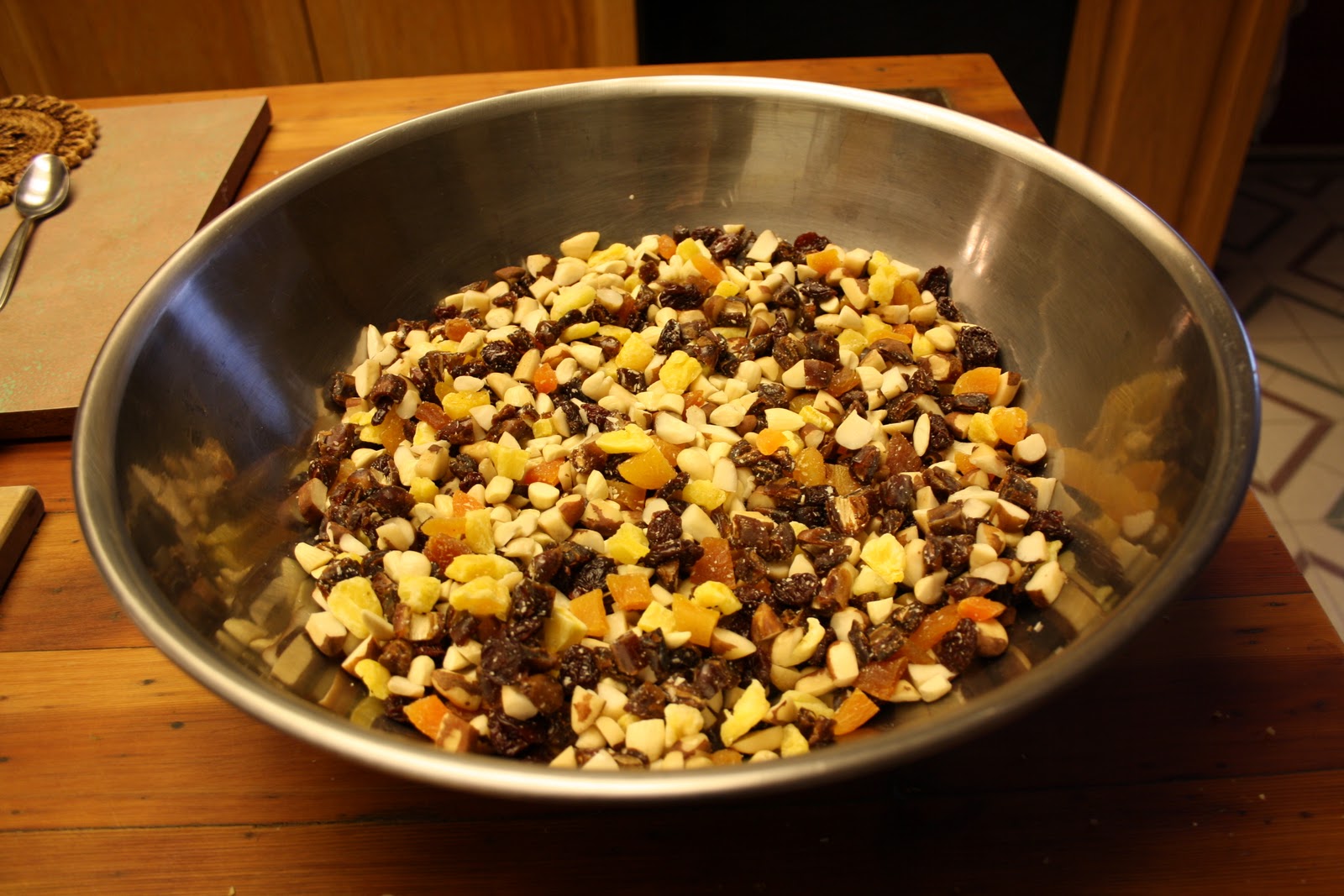
I cut the dried pineapple, apricots, dates, and cherries with scissors, chop the almonds and brazil nuts, and mix them all together in a large bowl.
A rich batter flavoured with vanilla and rum will bind the nuts and fruit together, deliciously I might add.
The cakes are ready for the oven.
They bake for an hour and a half turning golden brown and aromatic.
After the cakes cool, I wrap them in muslin and douse them in rum. Each week I will bathe them in more rum.
As they soak up the alcohol, the nuts and fruit cure to a slice-able state, and later in December, when we are putting up and decorating the Christmas tree, we will test the first cake and enjoy a slice with a glass of port. At least my husband and I will...the kids still won't touch the stuff. "Fruitcake? Hmm... no thanks."
That's alright, all the more for us. I'm willing to bet I could change their mind about fruitcake with some chocolate panforte, which I also plan to make this year.
*My husband borrowed the phrase from our nephew Christopher who used to call Panettone, the Italian Christmas cake, 'booze cake' when he was little. It was a favourite of his.
I first discovered 'real' fruitcake at the age of sixteen, when our family friend Catherine, who was trained as a pastry chef, gave my parents a cake as part of a Christmas basket of home-baked treats. The cake was dark, very dark, with a thick layer of marzipan frosting, and it exuded a fragrance so deep, so rich, as could only be achieved by many months' soaking in brandy. No dye-injected maraschino cherries here, only dried fruits and fresh nuts cured to a wondrous flavour which married well with the sweet almond paste - delicious, and meant to be consumed in small quantities.
Many years later, I read an article in Martha Stewart Living about fruitcakes. The article claimed to be able to change virtually every fruitcake hater's mind about this ancient dessert which in its basic form dates from seventh century Persia, and included several recipes with names like 'Chocolate Panforte' full of dried cherries and hazelnuts, 'The Dowager Duchess Fruitcake' spiked with sherry, and the 'Fruit and Stout Cake' doused weekly with 1/4 cup of Guinness (I presume the baker consumes what's left in the bottle?). The food editors' favourite fruitcake was from an Australian family recipe called 'The Backhouse Family Fruitcake.' I decided to try that one. It was delicious, and each November since, around the American Thanksgiving and the beginning of the Advent Season, I have made the Backhouse Family Fruitcake. My husband cannot imagine Christmas without a slice of this fruitcake and a glass of port, and I have come to enjoy the making and then weekly tending of what he likes to call 'the booze cake.'*
I begin by locating my battered copy of Martha Stewart Living, December 2000.
I cut the dried pineapple, apricots, dates, and cherries with scissors, chop the almonds and brazil nuts, and mix them all together in a large bowl.
A rich batter flavoured with vanilla and rum will bind the nuts and fruit together, deliciously I might add.
The cakes are ready for the oven.
They bake for an hour and a half turning golden brown and aromatic.
After the cakes cool, I wrap them in muslin and douse them in rum. Each week I will bathe them in more rum.
As they soak up the alcohol, the nuts and fruit cure to a slice-able state, and later in December, when we are putting up and decorating the Christmas tree, we will test the first cake and enjoy a slice with a glass of port. At least my husband and I will...the kids still won't touch the stuff. "Fruitcake? Hmm... no thanks."
That's alright, all the more for us. I'm willing to bet I could change their mind about fruitcake with some chocolate panforte, which I also plan to make this year.
*My husband borrowed the phrase from our nephew Christopher who used to call Panettone, the Italian Christmas cake, 'booze cake' when he was little. It was a favourite of his.
* * *
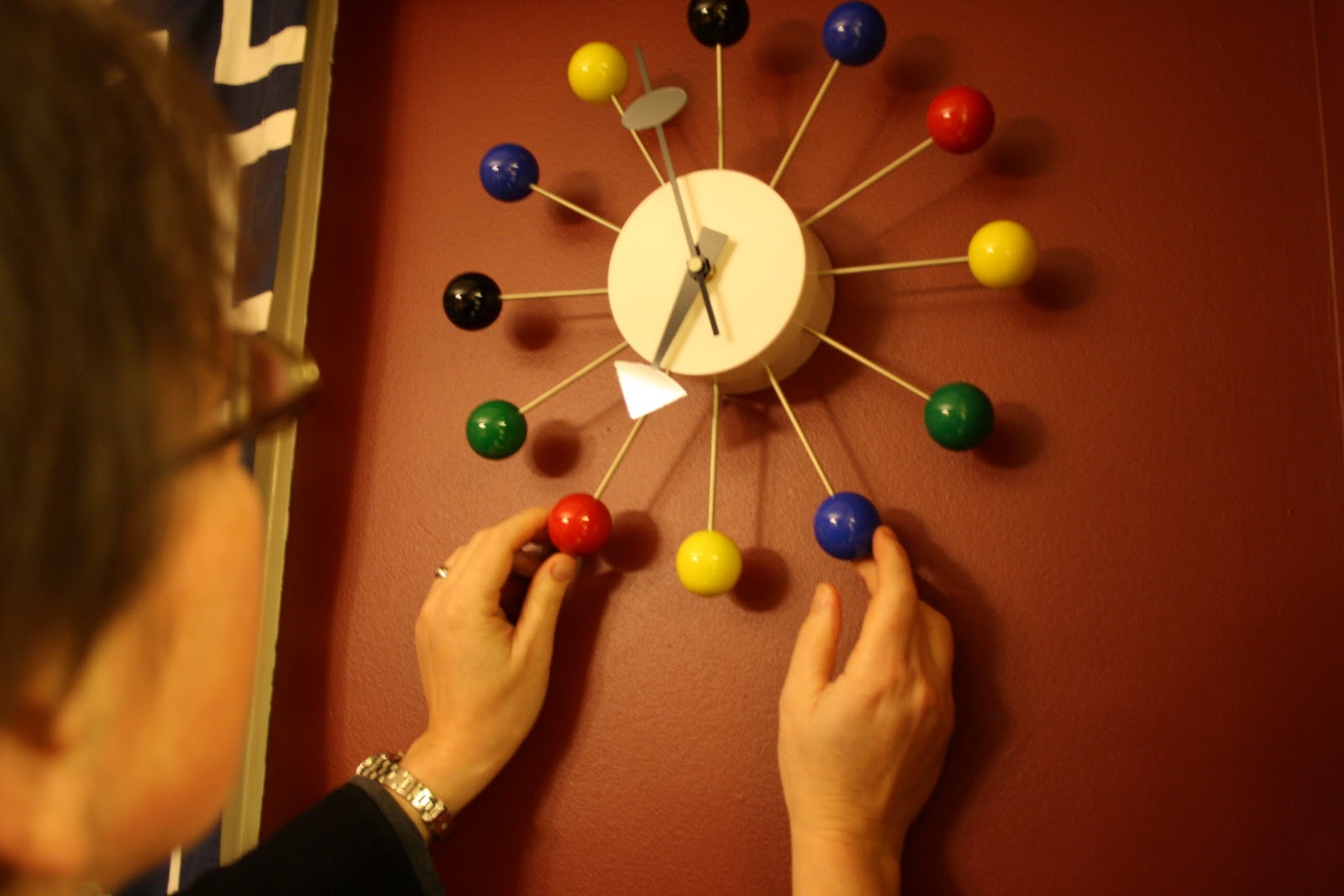
In other news...I was thrilled last week to receive, compliments of Lucille from Useful or Beautiful, her giveaway prize of a Nelson Ball Clock. Here, I give her a blogger's extra-large thank-you. The clock is admired by the residents of our house, as well as its visitors. I know we will enjoy passing the time with it for years to come.
Happy Weekend!
November 18, 2011
A Welcome Winterlude
Last week was this particular autumn's swan song. Raging against the cold nights, the leaves on the trees injected themselves with intense colour and the blue, blue sky and the snow-capped peaks made a contrasting backdrop for the sun-fired reds, yellows and oranges as they performed their dramatic finale.
Then came the mighty winds, the famous local blow-down-the-valley-tunnel winds. The leaves gave up their clinging ways and fell to the ground, creating colourful jigsaw carpets on lawns and sidewalks. Out came the rakes, the orange garden bags, and the kids in rubber boots and gloves. Out came the hot chocolate as a reward for their help and as a remedy against freezing wet fingers. Because of course, it had also rained.
Two days ago it tried to snow, but only managed some freezing pellets that melted on contact. Unfazed, Mother Nature dropped the temperature and last night, we had snow. Waking up to an inch of white covering fields, shrubs and rooftops, we all said, 'hurrah!' Snow is bright, snow is quiet, snow is much, much prettier than the shabby, sad grey-ness of cold weather rain.
Now in the afternoon the sun is out and the streets are shining wet with the melt. Bear Mountain looks eager to shake out her frosted fur, and there is just enough snow left on the lawn for a cat, or a ten-year old daughter, to leave her prints in.
November 10, 2011
One Unforgettable Meal
Maybe it was because I had been reading too many early 19th Century romantic novels (Jane Austen) that I decided, of all the choices on the menu, to order The Quail.The gentlemen in those novels are always going off shooting in the fall, and returning with all sorts of birds for the cook to roast over an open fire. Or, perhaps it was because, several years before, a family friend had arrived for a visit bringing with her a basket of tiny quail eggs which she pan-fried and served, four to a piece of toast, and they were so delicious that I thought the bird might be worth eating as well.
I was sharing an apartment with my sister and her husband, just off the colourful Commercial Drive in Vancouver. I was a student at UBC and living on a tight student loan budget. Eating out was a rare event, but one night my new boyfriend, my sister and her husband who was a masters student at UBC, and I decided to treat ourselves to a decent dinner at one of the Drive's many ethnic eateries. We chose a Mexican place with very plain decor - it looked like an office tacked up with cheap souvenir decorations - but with a reputation from at least one source for good food at reasonable prices.
I had eaten less than usual that day to make room for the Mexican feast and was starving by the time we arrived at the restaurant. Perhaps it was an off night for the cook because, while we all ordered our meals at the same time, we were each served at different times over the next hour and a half, with my boyfriend waiting ninety minutes for his meal. I cannot remember what the others ordered or if they enjoyed their food. Those details are eclipsed by the memory of the appearance of the small platter placed before me when The Quail finally arrived. I am not sure what I was expecting. Perhaps something like this dish described in Julia Child's wonderful book My Life in France:
The patron beautifully and swiftly carved off legs, wings, and breast, and served each person an entire bird, including the back, feet, head, and neck (when eating game, you nibble everything). He had placed the breast upon the canape, an oval-shaped slice of white bread browned in clarified butter, topped with the liver - which had been chopped fine with a little fresh bacon - then mixed with drops of port wine and seasonings before a brief run under the broiler. The sauce? A simple deglazing of the roasting juices with a little port and a swirl of butter. Delicious!
There was nothing gourmet about my serving of quail. Spread-eagled, beak up on a single, large piece of green lettuce, my poor little bird was charred to the bone like some kind of burn victim from the apocolypse. I looked down at my 'meal' and wondered what to do. In an effort to honour what I thought was some sort of Mexican delicacy, I took my fork and knife and attempted to scrape away some of the blackened flesh of which there was very little. I tasted it, and decided not to proceed. Still extremely hungry I picked at the lettuce and finished my beer.
We left the restaurant in a terrible mood, some of us still extremely hungry. I'm sure we went home and made some unromantic but satisfying toast and cheese. It was no accident that I spent the next phase of my life as an almost, very pretty nearly, vegetarian.
The other evening I assisted my pastry chef friend at her table at an annual event for local foodies. While my friend and I manned her table filled with hundreds of tiny blackberry buttercream macaroons and s'mores tarts (little graham cracker cups filled with chocolate ganache and topped with her famous homemade marshmallow which we toasted at some risk to ourselves using a butane blow-torch) her mother made the rounds to the other chefs' tables and brought us back tastes of everything. Over the course of the evening, we enjoyed chicken liver pate flavoured with brandy on rounds of sourdough baguette, tender rare bison, bocconcini skewers with cherry tomatoes, salmon tartare, various wines and flavoured mead. I was feeling adventurous by then and as I bit into a particularly foreign-looking canape I asked what it was. "Duck Confit with two kinds of duck!", said my friend.
"Ah", I said, and bravely finished my portion, washing it down with some lovely red wine. I think Julia Child would have approved of the duck confit, but I had to admit after tasting it that while I had made my peace with meat-birds long ago, I would never quite learn to appreciate anything more exotic than a plump, golden chicken or a wine-basted turkey.
Have a wonderful weekend, and if you go out for a meal try something new on the menu...or not.
Thank you Bill Watterson for the great comic from Calvin and Hobbes.
Subscribe to:
Posts (Atom)