May 12, 2014

Floating Down the River, Your Hand in Mine

My husband, half way through his two-year Outdoor Recreation program at Capilano University in Vancouver, was offered a summer job as a river rafting guide at Panorama Resort near the quaint and beautiful East Kootenay town of Invermere. Panorama is essentially a ski resort, but in a bid to be viable year round, offered reasons to visit in the off-season, too: great mountain bike trails, a swimming pool and tennis courts, and river-rafting on the rapids of the small and mighty Toby creek. A few days after our May 16th wedding in my hometown of Nelson, my husband and I filled our Toyota hatchback with the necessities of life and off we went amid cries of 'Good Luck!' and 'Let us know how it goes!' from family and friends.

Beautiful Invermere (not my photo)

Previous to our move to Panorama, I had been in touch with the good folks at Pynelogs Cultural Center, a converted historical log estate on the shores of Lake Windemere, and had been promised a job at the center. Upon our arrival, and after several phone calls, it became clear that, funding being what it was, my job had been reduced to a volunteer position. Pynelogs was at least a twenty minute drive down the mountain from Panorama and was often longer due to cattle on the road stalling the traffic and giving zero response to the blaring horns and shouts of drivers. As a newlywed with a husband returning to college in the fall, I could not afford to volunteer when it would cost me gas money, so after a short time of wondering what to do I fell back on my food service experience and applied for a seating host position in the Toby Creek Lodge Restaurant. I got the job and was introduced to the staff by the manager: "And this one's got a brain in her head, so don't mess around." An auspicious beginning.

Fortunately, my husband and I were given staff accomodation in one of the condominiums at the resort, so our living expenses were modest. We shared the condo with two other rafting guides - Derek, a friendly and very handsome young classmate of my husband's, and Finn, an Australian with a love for The Bottle and a rather surly disposition much of the time. He was the rafting crew leader, however, and it was important to keep on his good side. He was sometimes a benevolent roommate, and I remember his cauliflower cheese pie and his barbecued leg of lamb very well. So, my summer days, besides keeping house with three men, consisted of lounging by the pool - I remember reading The Razor's Edge by Somerset Maughm - cycling or going for drives on the dirt roads up behind the resort, throwing meals together with, as of yet, little talent in the kitchen, cheering at the TV with the guys during The French Open and Wimbledon tennis tournaments, attempting to play tennis with my sporty new husband, and seating guests (and clowning around with waiters) in the restaurant in the evenings. One night early on in my hostess career, and after the restaurant was closed, I sat down to the grand piano by the bar where the wait-staff were counting their tips and calculating my share. I began to play 'Fur Elise' by Beethoven, which I had known by heart for years. The staff must have enjoyed my music, for after that they told me if I played for them every night they would increase my share of the tips. It became a very satisfactory arrangement, as my husband and  I were able to live mainly on my tips and save our paychecks for the coming year back in Vancouver.

One of the great bonuses of my husband working as a raft guide was the free trip for both of us - which we rather optomistically called our honeymoon - rafting for a week on the Tatshenshini and Alsek Rivers in the Yukon Territory, to take place in the latter part of June. Clients payed $2600.00 each for a guided trip down those rivers, plus their air fare and accomodation in Whitehorse before and after the trip. We only had to get ourselves to and from Whitehorse, which we did in our car, driving twelve hours a day for three days through some of the wildest, most beautiful country I have ever seen. Wildlife appeared by the roadsides at regular intervals - grizzly bears, moose, deer, black bears, birds of prey, etc. We had been given the loan of a good 35 mm camera, bought several rolls of film and took along our little point-and-shoot for backup.

Grizzly bears by the road in Jasper National Park

A church in the lovely Hazeltons

After a day or two of sightseeing in Whitehorse - a city of approximately 15,000 people and with, I counted, 28 bars - the voyage down the rivers began at Haines Junction. Our two guides, Jim and Brian, told us the first leg of the trip would be a quick one with the river presently swelled with the runoff to twice its normal volume. We geared up in personal flotation devices, warm, waterproof clothing, and helmets. Everyone was given a paddle and directions in the vein of 'do what you're told if you want to survive'. The large rubber rafts, holding seven people each, rocketed along on the swollen river, and when we came to some narrows held in by sharp, rocky cliffs, it took everyone's work to keep the rafts on course. Our raft guide, Jim, kept us well away from the rocks and we got through the narrows just fine. Not so for the other boat, which bounced off a sharp rock on the cliff and gained a puncture in its sidewall. My husband spent the rest of our 'free' honeymoon rising each of the six days at dawn to pump up the punctured boat that had been slowly, sadly, deflating during the night.

Several of the participants on the trip were over sixty-five. One, a retired teacher and former mountain climber named Gertrude, was eighty-two. All of the retirees, (except the coiffed lady in the high-heeled rubber boots) hated people fussing over them, but all welcomed our help in setting up their tents and making camp each day. Luckily for us all, the weather was basically cooperative, and after that first day in the rapids, our trip consisted of calm days of floating downstream in our rafts, enjoying the opportunity to get to know each other, learning about the flora and fauna from Sid Cannings, our knowledgeable naturalist who was brought along for his expertise, and paddling when necessary. After an excellent dinner each night (the food was almost the best part of the trip, and being mainly cooked over a fire was generally given the adjectives 'Cajun' or 'blackened' when served with a grin by our fearless leader Jim), we spent our evenings around the campfire talking about the day's grizzly, moose, and Arctic Tern sightings.


Brian's boat


Moody skies

One of our tent cities

Views from a hike

Our boat's fearless leader Jim

Late in the trip we left the Tatshenshini River and joined the Alsek River, ending up at Alsek Lake. I will never forget the sight of that lake once the dense fog finally lifted in the morning. The beach, filled with clumps of unusual wildflowers gave way to a glassy blue lake with a backdrop of the Alsek Glacier. The lake was filled with huge, solid masses of blue icebergs which calved off the glacier at regular, crashing intervals. We paddled out to the icebergs, landing on one deemed fairly safe from tipping by our guides, and the group's cameras were put to work. My husband took roll after roll of film at the lake and I, armed as it were with the point and shoot, took one roll. Perhaps my insistence on taking photos on the little camera showed some foresight, for after the trip was over and we were developing our film, it became evident that something had gone wrong with the borrowed camera - none of the pictures turned out. The photos from the little camera turned out better than expected, although our entire collection consisted of only three rolls of photos from twelve absolutely glorious days of that once-in-a-lifetime experience.

Alsek Lake in the fog

Alsek lake, fog lifted, flowers abundant

Amazing icebergs


Since rivers lead ultimately to ocean, our trip ended at Dry Bay, Alaska, where we crawled out of our rafts, faces burnt and lips blistered by the reflected sun of six days on the water. We boarded Lady Lou, a reclaimed WWII bomber painted with Lady Lou herself high-kicking the Can-Can on its side. The interior of the plane was fairly basic, fitted like a bus, so I was astonished to be offered a drink and cookies by the well-dressed flight attendant who had to shout to be heard over the roaring engine and who exhibited great skill at keeping her balance as the plane charged along with typically northern spirit. We soared over the mountains, retracing our route down the rivers, taking half an hour to return to the spot we had left six days earlier. What a relief it was to shower and shampoo in the hotel room that two of the clients so kindly offered to share with my husband and I for our last night as a group. We dined that evening in Whitehorse' nicest little restaurant - all relieved to be going home to our own beds and bathrooms, but full of the wonderful week's experience on the rivers. We talked and laughed like we'd known each other forever. There was nothing to lose in bonding for a week because what we took away was so much bigger than that. The people part is mixed up forever with the scenery, the small hardships of camping in the wild, and the animals we were so blessed to see - a multi sensory experience to add to the store of memories of a young, married couple like us.

Our wonderful group of explorers, my husband and I
 in the back row,
second and third in from the left

The same could be said about that entire summer of 1992. I never saw any of those people again, not Andy the waiter who was so much fun to work with, not Finn nor any of the others - though I did see Derek once at a college function several months later. Eighteen years later we stopped in Invermere on a summer holiday and showed it to our kids. The town was even more developed than it had been in 1992 when the lake was completely surrounded by summer homes built by wealthy Albertans. I am sure Panorama Resort has grown a lot since then as well. We have changed, too, of course - twenty-two years, several moves and four children later.

Recently, I went through the entire box of photos from our trip. We had been invited to a party where each guest was asked to bring a show of just ten slides. I spread all the photos out on the floor trying to remember their exact order. I chose eighteen, which my daughter helped me to scan. Then, I chose the final ten for the party. As I went through the photos, I remembered I had kept a journal on the trip. I re-read the journal and relived my honeymoon, recalling little sensory experiences and feeling so grateful that I had those memories, those photos and that written account to go back to every now and then when I wanted to relive that adventurous time in my life when my husband and I were just starting our own journey together down the curving, varied, beautiful river of life.


April 30, 2014

All Good Things Come to an End


The Agassiz Tulip Festival is done for another year. Yesterday was our last day. Due to a couple of days of heavy rain this past week, the flowers took a beating; damaged flowers invite disease, so it's 'off with their heads!' to protect the growing bulbs. The field workers will now be left in peace to tend the fields (and turn their tractors around without waiting for someone to move their tripod), and the First Nation community that owns this land will return to normal life once more.

I love working at this festival. Thousands of people flock from the nearby cities to enjoy the endless colour and scenery. As they paid their entrance fee their shoulders would visibly relax and their faces open in a wide smile as they exclaimed at the sight. They would often be so distracted by the rainbow of flowers that they would ignore the many, many strategically placed signs around the forty acres instructing them to stay out of the rows, to refrain from picking the tulips, and to watch for machinery. Field staff in yellow hats were kept hopping as they tried to keep people from trampling the tulips in their quest for the perfect photo. I'm not sure how many times I repeated the 'Field Guidelines', told the story of the life cycle of a greenhouse tulip, gave directions to the washrooms or told visitors where to park their cars, but that is what a host does, she treats every visitor as if he is her first.

As to be expected I am beyond exhausted today. I am also wondering if the four women who spent an hour at the festival on Wednesday, a rainy, freezing cold day, wearing high heels and light jackets are suffering from pneumonia. While the crew and I struggled to stay warm in layers of wool, polar fleece, and gore-tex, these women posed for each other, smiling and laughing. I remember watching one woman in particular from the shelter of the tent. She stepped, in suede pumps, nylons and mini-skirt into a muddy opening at the front of a row of yellow tulips, removed her leather jacket to reveal a short sleeved red silk blouse, and posed, head cocked to one side for her photographer friend. The crew and I looked on in amazement and shook our heads. Crazy city people.

Last Sunday, our busiest day, I was dropping off my daughter's friends at their farm. Their father Henry, and his father before him, has been working that dairy farm for decades. It was my day off, but I had just come from the tulip fields where my son was entertaining the crowds with his violin (and making piles of money in tips, I might add). I exclaimed to Henry about the thousands of visitors that sunny day. "What are they all coming for - just to see a bunch of tulips?" he asked shaking his head in disbelief.
"Think about it," I said. "A lot of these people live in apartments in buildings made of concrete, steel and glass, and linked by asphalt roadways. To them, this is Nirvana out here. You should see how excited they are."
"I guess so," he said, still incredulous. "But I still don't see what all the fuss is about."
Crazy country people.

The photos above are mine:
1) Monte Carlo double tulips
2) a rogue red among the Leo Visser tulips
3) the view East
4) looking back on my way home from work

I wrote this post back in 2010, but much of it still applies this year as we come to the end of another great festival. The crowds this year doubled last year's and we are having to continually make crowd control adjustments. 

April 18, 2014

Art Projects

I never considered myself an artist. I had dabbled all my life in drawing and painting because, rather than an Easy Bake Oven and Barbie's Dream House, the children in my family were often given art supplies as gifts and my mother supplied an endless stack of drawing paper, even if it was just the backs of photocopied documents from her work. At school I favoured band and jazz choir over art class - somehow one had always to choose between the two - but by Grade 12 I had decided that I would make room in my schedule for art class. That class became an oasis for me and stands out as a memorable time full of colour and the meditative, expansive work of making art.

I did not go on to become a visual artist, but I did learn a great deal from my teacher, Ms. Konkin. She was a pretty, round-faced blonde woman with striking blue eyes. She was calm and honest about our work. I only remember being enthusiastically congratulated on one piece, which was a drawing of a glass of water with a spoon in it. I suppose I had captured the visual effect fairly well. I no longer have that drawing, but I do have a painting I did as my major project. I was studying dance at the time and was completely in love with that particular art form. I had a poster on my bedroom wall of a female dancer in a black dress leaning back and kicking one leg out. Her strong pose created a beautiful line. I decided to paint her balancing on the moon with a backdrop of a city scape, while kicking her foot into a blazing sun. The end result of the painting was certainly not technically brilliant. Against Ms. Konkin's advice I chose it from all my work to enter into a district student show down at the mall. The work was being judged by a famous local watercolour painter, Les Weisbrech. He didn't think very much of my painting, and when I looked at my painting through his eyes its faults glared painfully at me. Some time later I brought my painting home and showed it to my mom. She happened to love it, which took me by surprise, so I gave it to her. It hung in her bedroom for at least twenty years. She gave it to me and it now hangs in my bedroom. For all its faults I love it now. It seems to contain all the wonderful naive optimism that youth holds about the future. I truly thought the world was my oyster back then, and I was ready to take it on like my 'Stepping Out' dancer. Now, she reminds me of the beauty of innocence and to embrace life.


As part of our study that year in Art 12 we worked with clay. I particularly enjoyed working with the delicate porcelain clay, making pieces of jewelery and a teacup, if I remember correctly. We learned to throw pottery on the wheel and to my surprise all the skills I had learned making bowls with our old family friend Carol when I was little had vanished. One assignment was to make a free form sculpture with clay. We could not use the wheel, but we could use as much or as little clay as we liked. As I played with the lump of clay in front of me and listened to Ms. Konkin's guiding words about the options before us, a figure seemed to speak to me out of the clay in my hands. I had worked hard in high school to defy labels. If one day I spiked my hair and wore a man's suit and tie, the next day I wore a trendy Benetton rugby shirt and jeans, but by Grade 12 I had given up the fight. I was starting to mature and to relax into myself. If people wanted to label me I no longer cared so much. I took one lump of clay and formed it into a cross about eight inches tall and four inches across. I took another lump of clay and formed it into the figure of Jesus with his arms extended and his head falling slightly to one side. I placed him on the cross and added a crown of thorns and tiny nail heads in his hands and feet. Ms. Konkin came around to check on our progress. I believe she was stumped when she arrived at my place at the secular high school table, and out of the corner of my eye I saw one of her eyebrows rise. But, to her credit she said nothing critical at all about my choice of subject, and I offered no explanation. All our pieces were fired in the kiln and mine survived the oven despite its delicacy. I carefully wrapped it in paper and put it on the top shelf of my locker.

A few weeks later It was the end of the school year and I was cleaning out my locker. Somehow the clay crucifix fell to the floor and broke into six pieces. I gathered them up and was looking at them sadly when my friend Rachel with whom I had gone to school since we were in Grade One at St. Joseph's offered to fix it if she could keep it. I said yes. Years later I went to visit her, and there was my little mended sculpture hanging on her kitchen wall. "I love it," she said.

Yesterday I found out from a friend that Ms. Konkin who had also been my Home Economics teacher in, I think, Grades 10 and 11 is retiring. My friend posted the news on Facebook and as I read through the thread of comments my year with Luba Konkin as my art teacher came flooding back. Like so many rooms where the arts are taught in schools, Ms. Konkin had provided a space where creative and often sensitive souls could relax and feel appreciated and encouraged to do what came naturally to them. Teachers around the world who do the same are worth their weight in gold.

April 9, 2014

Humility, the Underrated Virtue


I was talking recently with an artist at the reception for his show of folk art at our local public art gallery. I commented on the fact that one of the themes he was exploring with his art was The Seven Deadly Sins (lust, gluttony, greed, sloth, wrath, envy, pride), and their antidotes, The Seven Heavenly Virtues (chastity, temperance, charity, diligence, forgiveness, kindness, humility) - other virtues exist, like faith, hope and charity, but he had not included them in this particular set of works. One painting listed the virtues in various shades of pink. Another listed the sins only in black and white. Some of his works featured all fourteen sins and virtues in a jumble of blocks of colour painted on handmade wooden benches. Several of these benches were distributed around the room and he invited me, as he and his wife themselves had done, to sit down on one of them while we chatted. He told me he found the subject of the sins and virtues of great interest and he hoped with his art to encourage people to talk about them more. I took that as a cue to do so because a thought occurred to me recently that the virtue of humility is greatly underrated in our world today. I told the artist that I believe many of the societal problems we suffer could be prevented if we only came at things with a bit more personal humility. And because I love a good philosophical discussion.

I gave the artist an example of what I thought having humility meant: say we find ourselves in conflict with someone, perhaps a spouse or family member. Our first reaction may be to find fault with them. Having true humility would cause us to look into ourselves first, to ask ourselves, what might I have done to cause this conflict? Or at least to contribute to it. The effect of humility in this situation would be an automatic decrease in the level of blame we might put on the other person and a desire to resolve the conflict in as peaceful manner as possible. If we are the first to apologize, we can also be a good example to the other person, causing them to try to resolve any future conflicts peacefully, too. We don't have to be doormats, we just have to desire peaceful, functional relationships with those we spend the most time with and realize our role is often to give them the benefit of the doubt. Which means being humble and not always having to be right.

One definition of humility I found was this: a modest opinion or estimate of one's own importance. Humility is a tough concept for many of us. We in the western nations are taught to be individualistic and to be on a constant and relentless quest for personal material comfort and security. We sometimes push our own agenda in order to elevate ourselves above the next person, because we see our needs and wants as more important than theirs.

In my husband's position at a 300-plus room hotel, hearing a wide range of complaints is part of his job. However, the stories he sometimes comes home with are astounding. People are often so quick to lash out, to blame, to scream at the staff if they are unsatisfied. They are sure that their needs are the most important thing in the universe at that moment and that everyone within a 200 meter radius needs to hear about it. Perhaps they were ignored as children and have an inner conviction that volume, anger and bullying is the way to get attention, or perhaps they learned as children to scream and yell until they got what they wanted because that tactic wore their parents down, and it has continued to work in their adult lives. And yet other people, when they have a grievance, share it with the staff in a way that is polite and respectful and not at the very top of their voice. Perhaps when they were children they were taught to ask for the things they wanted, but learned to accept the occasional disappointment as part of life. 'You can't always get what you want, but if you try sometimes, you get what you need,' may even have been sung to them from time to time. Humility is acknowledging the respect due to one human being from another. Humanity is in essence ironic. Although we are all lowly beings on this planet, we mere specks in the universe also have great power and responsibility to try and make things better for each other, or else life is endlessly cruel and competitive. Unfortunately, 'Do unto others as you would have them do unto you,' is often forgotten in the service industry because the idea of having people at our service seems to give us a heightened sense of our own importance, however fleeting, and thus, the one rendering the service a lower status in our estimation. Else, why would we feel free to scream at them for making a mistake on our bill or bringing us the wrong sandwich?

Humility also naturally increases empathy. When I see someone begging for food on a city street or scoping out the ditches and public garbage containers for bottles and cans to bring to the recycling depot in order to get a little money for their needs I try to imagine how many degrees of separation actually exist between them and myself. The line between their standard of living and mine is fragile and I am perfectly aware of that. I have inner resources to draw upon if I ever found myself alone and cut off from the present comfortable income I am priviledged to live on, but life holds no guarantees for any of us. Everything we cherish could be taken away from us at any moment and the idea of that helps to keep me humble, and it helps me to look upon the homeless and the needy with empathy because with a little stretch of the imagination I can put myself in their shoes. I know how hard it would be to maintain some sense of dignity. The same goes for my fellow humans living in poverty and/or under oppression around the globe. The awareness of my great fortune in being Canadian humbles me enough to want to do what I can for those who rely on the generosity of others in order to put their children in school and food on their table, as well as making sure I am paying attention to what is going on in my own backyard to make life fair and equitable for all citizens.

Since talking with the artist while sitting on his benches decorated with the sins and virtues, I have had much to ponder, so I suppose his aim worked with me at least. I know I have some stuff to work on, but the great thing about virtues like humility is that they are achievable. Practise makes perfect. We just have to start small and take gradual steps toward being more human. Humility and human start with the same three letters, which is no accident. The Latin root word 'hum' means in English, 'ground'. The way I see it is this: if we approach life from the humble ground up we will realize we are all deserving of love and basic human respect from each other no matter what our status or gifts may be. If we act on this realization not only will our immediate circle benefit, but the ripples of our seemingly small actions will move out beyond us and into the world, and our collective actions will achieve great things.


March 31, 2014

A Spring Poem that Isn't, and Some that Are


I will not attempt to write a poem about spring
I fear it would not amount to anything

Bluebells, lambs and other new creatures
and subjects which a spring poem usually features

Would certainly grow weary being under my pen
Their glory not enhanced by being written of again

Although the urge rises up in my heart
"The sunlight on verdant green buds..." I won't start

Not writing such a poem is my gift to you
So, like me, read some good ones and feel spring anew!


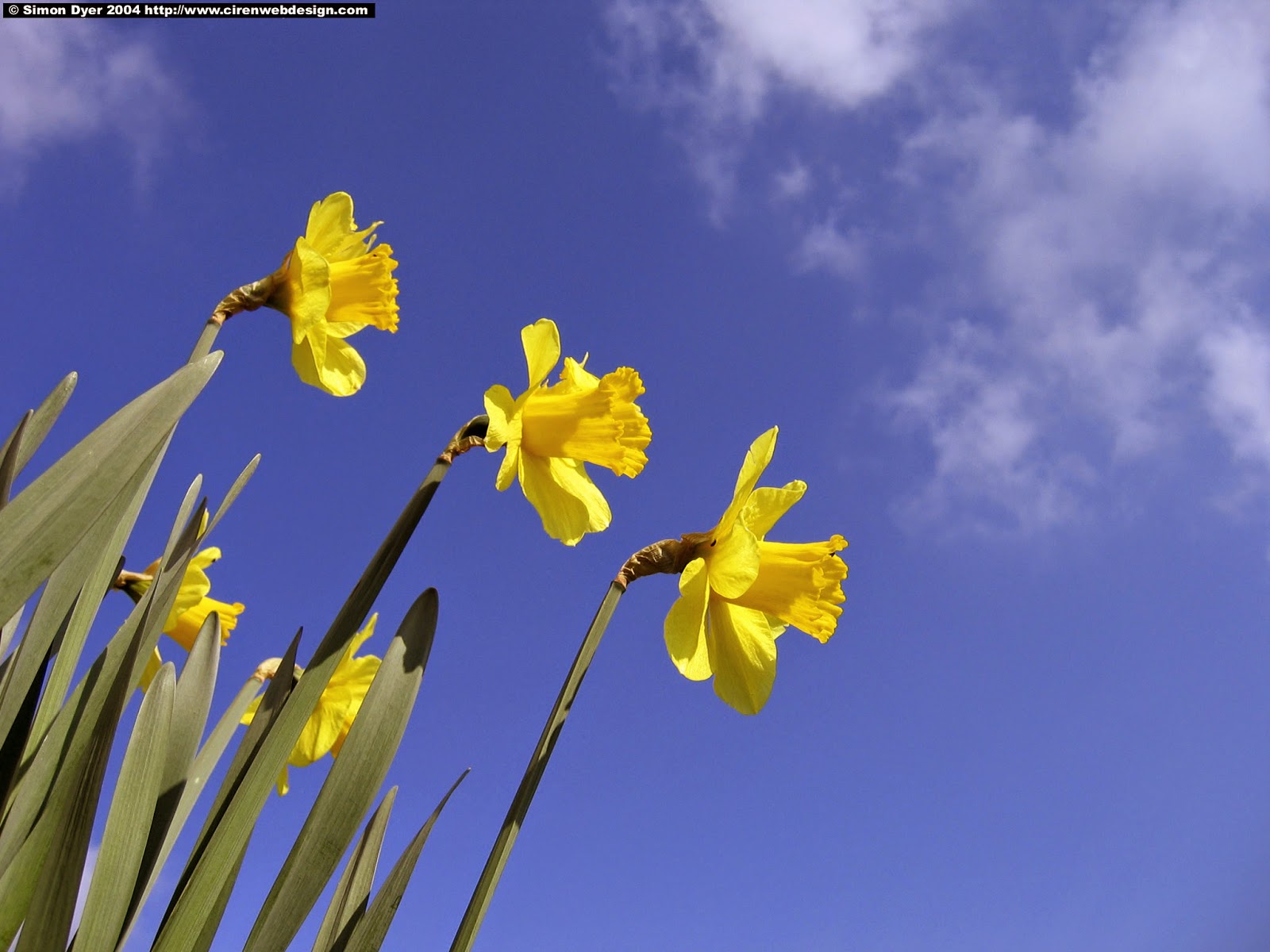
Daffodils by Mark Slaughter

I fell in love - 
Taken by the innocence of 
Child-face daffodils: 

Their perky April fanfares - 
Clarion calls from yellow-ochre brass bands - 
Presaging, rejoicing, calling us: 

"Here we are! Here we are!'


Spring by Gerard Manley Hopkins

Nothing is so beautiful as Spring - 
When weeds, in wheels, shoot long and lovely and lush;
Thrush's eggs look little low heavens, and thrush
Through the echoing timber does so rinse and wring
The ear, it strikes like lightnings to hear him sing;
The glassy pear tree leaves and blooms, they brush
The descending blue; that blue is all in a rush
With richness; the racing lambs too have fair their fling.

What is all this juice and all this joy?
A strain of the earth's sweet being in the beginning
In Eden garden. - Have, get, before it cloy,
Before it cloud, Christ, lord, and sour with sinning,
Innocent mind and Mayday in girl and boy,
Most, O maid's child, thy choice and worthy the winning.


Today by Billy Collins

If ever there were a spring day so perfect,
so uplifted by a warm intermittent breeze

that it made you want to throw
open all the windows in the house

and unlatch the door to the canary's cage,
indeed, rip the little door from its jamb

a day when the cool brick paths
and the garden bursting with peonies

seemed so etched in sunlight
that you felt like taking

a hammer to the glass paperweight
on the living room end table,

releasing the inhabitants
from their snow-covered cottage

so they could walk out,
holding hands and squinting

into this larger dome of blue and white,
well, today is just that kind of day.


And we can even listen to Philip Larkin read his poem, The Trees.

There are plenty more spring poems to be found. Some more good ones are here. Enjoy! The first three photos I found on Google Images, but the last one is of a tree in my garden last spring.


March 22, 2014

When the Silver Lining Fades


I tend to subscribe to the idea that Every Cloud has a Silver Lining. I just find it pays to be positive in general. I am not always such a Pollyanna type. I have my dark hours of self-doubt and of disgust with the world, but overall, as I heard someone say in a documentary about the uncertain future of the planet I agree that 'Pessimism is not a strategy." (Not that I am a strategic person. I tend to float along taking opportunities as they present themselves - or not - and going with my instincts.) When unfortunate circumstances arise, I tend to find the upside fairly quickly, as long as the circumstance does not last too, too long.

Take the last couple of weeks of my life as an example. First, my husband caught a cold. I had it three days later, and much worse than he did. It was just a cold, I told myself. I could still read, eat well, sip hot lemon and honey. It wasn't bad at all, really. I got better for two days and my eldest daughter caught the cold. I roasted a chicken, made soup, cleaned a little and caught up on the laundry, glad to be feeling better enough to look after her. Then, my husband came home with a tale of a guest at his hotel who had spent the day vomiting. He was concerned about catching her flu. That night, he came down with stomach flu and I was relieved I could help him out in the middle of the night when his symptoms were at their worst and he fainted in the upstairs hallway. I am not sure if it was the guest's flu or just part two of whatever we had started with, but two days later, I came down with it. I spent three days in and out of bed. I would think I was getting better, only to be up half the night with stomach cramps and spend the next sleeping to recover. Still, I was grateful that my daughter was feeling better and could help with meals, and that my husband had recovered so quickly from his flu and could look after everything else. The silver linings were still within view.

One evening, my eldest daughter, by then well recovered from her cold, asked me how I was feeling."It's only a matter of time," I said.

"Until what?" she asked me, eyebrows furrowed, daring me to be pessimistic about my prognosis.

"Until I feel better."

"Oh," she said, brightening a little as if to say, "That's the mother I approve of." She despises other people's drama, just as I did at her age.

On the ninth day of my on-and-off illness, my husband came home early from work. He came to see me in our bedroom. I admitted to him I was completely miserable and frustrated, and burst into tears. After commiserating with me he went upstairs to see our youngest daughter who had, so far, escaped any version of the flu and was just home from school. I lay in my bed, comfortable, and somewhat relieved after my tiny nervous breakdown, but I still felt plenty sorry for myself. My cache of silver linings was all used up, I thought. I would just have to wait until this misery passed.

A few minutes later my husband returned to our room and poked his head around the door. "There's an email for you," he said.

"I'll read it later," I said, waving the idea of dealing with emails away with a limp hand and reclosing my eyes.

"It's from a movie magazine in Australia. They want to buy some of your photos. The ones you took of the set of Wayward Pines."

I opened my eyes and looked at him. A smile crept into the corners of my mouth. "Really?" No one had ever offered to pay me for any of my creative product before.

"I thought you'd like to know," he said flashing me a little grin and heading back upstairs. Sometimes it is unnerving to be known so well.

I had slept most of the day and suddenly, I felt hungry. I had been subsisting for the past several days on bread and cheese, crackers, apples and yogurt. I asked for a bowl of my homemade granola mixed with yogurt. I ate it all and began to feel slightly stronger. My youngest came down to visit me and I asked if she would like to watch some TV with me in my room. She went upstairs to get a DVD and returned to announce that her dad suggested we all watch it upstairs. I decided it would not kill me to get up and join my family in the living room. I made myself comfortable in my usual chair with a blanket and we watched an episode of the comedic classic Jeeves and Wooster. I would read that email from Australia later. For now, it was enough to know it was there waiting for me. Just when I thought the silver linings had deserted me, one had shown up gleaming and, even if it came to nothing, was giving me hope for the moment.

My husband made a light supper. I ate it and felt stronger still. The next day I read that email from Australia. It even seemed legitimate.

March 7, 2014

The Taxi Driver


I had taken the bus from the East Vancouver basement suite that I shared with my sister Clare and her husband to Simon Fraser University where I was to meet up with my girlhood friend Tanja. The bus ride had involved a couple of transfers and a bit of waiting at bus stops. In the waning daylight the trip had been alright, but I was not anxious to repeat it in reverse, in the dark, alone. I had supper with Tanja and her boyfriend at one of the campus places and we lingered, talking for several hours. When it was time for me to return home I decided to spend some of my precious student fund on a taxi, believing it to be the safer option for me at that hour of the night.

The taxi arrived and I said goodbye to my friend. I climbed into the back and gave my direction. The taxi driver was the chatty sort and he immediately began to talk. I soon realized that what he said did not make a lot of sense. He was asking me about how school was going in St. Catherine's. I told him, no, I was in my first term at UBC, and sat back to enjoy my door to door ride home. He kept on about St. Catherine's, which was a town in Ontario, over half way across the country. After trying to correct him once more, I realized my efforts were futile. He kept asking me about people and places I did not know in the least. I began to feel uneasy, wondering if my chauffeur was quite right in the head.

My taxi driver drove a bit erratically, turning down alleyways and cutting across blocks. He told me he was going to stop at a convenience store for a Coke. Did I want one? I told him in no uncertain terms, and perhaps with just a tinge of hysteria, that he was not going to stop and get a Coke, that he was to take me straight home. I was genuinely frightened by then. I wondered if I was going to get home. I wondered if he really meant to stop at a convenience store or was it an attempt to stop the car in some out of the way place where I would be raped and chopped up into pieces, stuffed in a duffle bag and dropped in a dumpster in some sketchy back alley where I would be found by some poor person searching for discarded food, my murder reported the next day on the front page of The Province. (My gift of imagination did not serve me well just then.)

My heart in my throat, I sat forward, gripping the vinyl trim on the edge of the back seat while my driver chatted cheerfully and nonsensically. He took me on a labyrinthian journey, none of which I recognized. Just when I was thinking about opening the car door and flinging myself out onto the pavement like they do in the movies, he turned onto our block and pulled up in front of our house. The trip that had seemed endless had taken, in actual fact, a fairly short time. His route, while unrecognizable to me - I had only lived in Vancouver a couple of months and was geographically challenged at the best of times -  had been a short cut accomplished by someone who knew the city like the back of his hand. With shaking legs I got out of the car. "How much do I owe you?" I said as calmly as possible. He quoted me a fair price, less than I had anticipated in fact, and I paid him.

My sister was home when I entered the house whitefaced and completely unstrung. I felt half relief and half guilt for misjudging my driver. I am sure now that he was a decent person, although I wondered if he had been high on some substance. Or maybe his state of mind was a mixture of working a double shift on very little sleep and good memories of a youth spent in St. Catherine's. I could only speculate. In any case, I felt lucky to be alive and extremely glad to be home with my sister. Clare gave me something to drink to help bring the colour back into my face and calm my frazzled nerves. My boyfriend (now husband) drove over from Kitsilano on the west side of the city to comfort me. I am not sure I ever quite fully recovered from my fright. I refused to go anywhere at night alone for the rest of the year.

While I was having a good experience at UBC and enjoying living with Clare and her husband my adventure with the taxi driver did little to ingratiate me with the city of Vancouver as a potential home in the future. I lived there on and off for the next three years, developing a love/hate relationship with the city. The love was for its beauty and variety, although I now know that I sought out places that reminded me of home: water, lakes and mountains. The hate (perhaps a slight exaggeration) was for the fact that I never seemed to fit in there. Too sensitive and inexperienced to let the sad scenes of my neighbourhood fall off me like rainwater off a duck's back, I was haunted in particular by the mute woman who accosted me every time I walked down the street, begging me for money while she shoved the scars on her wrists and throat in my face. Her plight, so dramatically contrasted by the ease and comfort I perceived in the wealthier neighbourhoods of the city, filled me with a sense of helplessness. I knew that my coins could do little to make her life better.

My boyfriend and I got married a year and a half after the taxi driver incident. At the end of my third year in Vancouver, my husband finished his practicum and was offered a job in the East Kootenays. I was ecstatic. The only thing I seemed to miss after we moved was the Greek fish market on Commercial drive. I could buy two plump, fresh fillets of sole for a song and bake them up beautifully with a sauce of dill and yogurt.