Showing posts with label art. Show all posts

February 3, 2026

Hoping Mechanisms

One day last week I let myself get buried by all the commentary blasting out from social media on the current events in our world. I felt desperate and sad and despairing and afraid, and I couldn't get to sleep that night. I vowed to not let that happen again, and so far this week I have not. Watching the news to stay in the loop is one thing. Absorbing all the ways in which celebrities and various social media regulars emotionally share their responses to it is quite another. I am not saying they don't have the perfect right to share their responses, it's just that I don't have to subscribe to all of it. The human body was not created to be a full-time disaster response machine. We need to be informed, yes, but we also need fresh air, we need healthy boundaries, we need creative outlets and meaningful pursuits, we need community, and we need, most of all, hope.

I remember during the first year of the Covid pandemic, someone wisely said that how you respond to crisis affects how your children will respond, so be calm and carry on. Answer their questions simply and honestly but don't dwell on the negative and don't freak out every time the news gets worse. Go to the trusted source for advice on how to cope. For me that was listening to Bonnie Henry calmly and compassionately deliver her updates. She never failed to help me feel under control and hopeful that we would all get through that trying time together. For anxious me with one teenager still living at home, staying visibly calm all the time was a tall order. I had to develop a routine of coping with my anxiety as I had also lost my job due to Covid. I went for long walks every day listening to a lot of Steve Martin and the Steep Canyon Rangers. I made healthy food for my family. I did little art projects. I reached out to family and friends. I watched the World War II-era mystery series Foyle's War from start to finish to remind myself that humanity had lived through tough times before and we would survive...well, most of us would. 

The lessons of the Covid pandemic still apply in the bizarre world climate of today. Having access to 24/7 news and commentary doesn't mean we don't have the power to choose when and how much we absorb. We are all different. Some people can take a lot. My husband for one. He can get up in the morning and hit the internet on full blast. It doesn't seem to put him on the wrong foot for the day. I have to ease in with 'coffee and contemplation' as my brother-in-law Brent calls it, with some prayer to help me keep perspective, journal writing, Wordle and Connections puzzles. Then, I might look online for some funny content. I'm not ready for anything more serious until at least mid morning. At least one day per week I avoid social media altogether to concentrate on creative projects. I need that healthy boundary to remain hopeful and would argue that most of us do.

Years ago my eldest son came home from high school and said, "Hey Mom, do you want to hear the world's shortest poem? I heard it in English class today." "Sure" I said. "Okay, here it is" he said. 

Hope? Nope.

That was the poem. Although probably the honest feeling of the poet when they wrote it, flat out depressing. 

I prefer this one by Emily Dickinson:

“Hope” is the thing with feathers -

That perches in the soul -

And sings the tune without the words -

And never stops - at all -


And sweetest - in the Gale - is heard -

And sore must be the storm -

That could abash the little Bird

That kept so many warm -


I’ve heard it in the chillest land -

And on the strangest Sea -

Yet - never - in Extremity,

It asked a crumb - of me.


Hang on to your little bird, friends. We will get through this.

'til next time, 

Rebecca


May 29, 2023

Material Girl

Until my eldest sister moved out I shared a room with my brother. We were kids number five (him) and six (me) in the family. As we lay in our bunk beds we would play a little game. We called it, "What would you rather have?" The game went something like this: 

"What would you rather have? A million dollars or all the cars you wanted for the rest of your life?" My brother was really into cars.

or: 

"What would you rather have? A big house or a lifetime supply of chips and dip?" Or toys, or banana splits, or whatever highly desired, yet rarely enjoyed, item we could dream up.

We would then discuss our options and give reasons for both choices. I can't remember what conclusions either of us made, but I remember how seriously we took the game. I remember my brother saying his dream was to have a nice big house when he grew up, with a rec room with a big TV where all his friends and his kids' friends could gather, and he would supply them with all the chips and dip they desired. I was only ten and my dreams for the future were hazy, and not quite so specific. I just knew I wanted more than we had. We went to an independent Catholic school, the only 'private' school in our town, and many of our schoolmates came from middle to upper class families who wanted their children in a private school, Catholic or not. So, most of my classmates had much more in the way of material goods than I had. I remember getting into some light trouble lying in Show and Tell. I told the class my mom had brought me a rabbit from California. My mom found out about the lie when my Grade Two teacher phoned her and asked if I could bring the rabbit to school. "Why did you tell them that?" my mom asked. I told her I was sick of everyone else having fancy and exciting things to bring to Show and Tell. My mom had not yet been to California, let alone gifted me a rabbit. 

Even if ours was not a rich, or even middle class family, we were a creative and lively one, and we all had dreams. My dream when I was a kid was to, one Christmas, be given an Easy-Bake Oven. I thought anything I saw in Saturday morning cartoon ads as otherworldly, highly desirable, and mostly unattainable, but I pined for an Easy-Bake Oven against all odds for at least two years. I don't remember making Christmas lists, I just hoped if I wished hard enough, and circled it in the Sears Christmas Wish catalogue, I would get one. I never did get one, but my closest friend got one. When I finally got to play with it with her, we baked a cake from a mix that came with it, and I suppose that was kind of exciting. That was probably also when my dream for an Easy-Bake Oven ended. Life is like that sometimes. 

From Easy-Bake Ovens I moved on to dreaming about clothes and fancy bedroom sets. I remember a black velvet outfit in the Sears catalogue that I would quite literally dream about. I didn't get that either, but my mom was very understanding about clothes and took me shopping at the start of each school year, so I could have at least one outfit that was not a hand-me-down. I dreamed of a canopy bed - the Holly Hobby one - also in the Sears catalogue. One day when I was invited to another school friend's house her grandad said he had a surprise. He had bought her a complete white bedroom set from Sears, with matching linens, just like in the catalogue. I think I was too gobsmacked to be envious. I did, however, come home from her house once and began to list in great detail, all the Barbies and Barbie stuff she had. After about ten minutes of this, my mother rolled her eyes and asked me to please stop.  

When my granny died we inherited a lot of lovely stuff that she had owned. I remember well the day when the truck arrived. I came directly home from school to help my mom unpack the many boxes of crystal glasses, dishes, and furnishings. Needless to say, I was enthralled. What extra money my parents had they spent on paintings by local artists, books, and records, not pretty dishes and rose coloured sofas. I had been once to my Granny's home in Delta. It was very elegant, very colour-coordinated. I was proud that my family now had lots of pretty things in our old house.

In the Eighties, at the height of Yuppie-dom, I began to dream of a lifestyle such as I saw on TV and in the movies I went to. The clothes! The houses and apartments! The art and decor! The antiques! Let's face it, I loved stuff. I didn't exactly have the income of a Yuppie, but I was good at faking my appearance as one from my years of haunting thrift shops for vintage clothing. I was developing a great interest and passion for art and pledged to buy one piece of art per year. As a teen making my own money, I also spent it on clothes and makeup. The wall by my bed was a collage of fashion photos cut out of magazines. After I moved away from home to go to university, I had a lot less disposable income, but I continued to hunt for designer clothes in the many consignment stores in Vancouver.  After I got married and had small children, I had even less money to spend on myself, so my collecting was streamlined to whatever vintage dishes and objects I could find at garage sales and thrift stores. I would give myself a strict budget and only buy what I really liked. My desire to be a Yuppie was outstripped by real life.

Now that I am an empty nester, I have more disposable income than I have ever had, and can pretty much buy what I like, within reason. The thing is, I no longer want to accumulate stuff. I still buy a piece of art now and then, and I love to buy gifts for other people, but my desire for stuff seems to have mostly run its course. I want different things from life now, and they aren't material things. My dreams now run to seeing my children happy and having good relationships with them, and to being able to travel to visit family and friends. I care a great deal about my health and my husband's health, and our quality of life. I like to explore new places, even ones that are near home. I do buy books, yes, that is an indulgence that seems necessary to my happiness. And just a few weeks ago I bought a pretty vintage china teapot at the closing out sale of an antique store. I just could not resist. Old habits die hard, I guess.

Did my brother get his big house and his endless chips and dip? He got a sweet, mid-century house of modest proportions in Calgary. He has three great, grown-up kids and hosts many dinner parties. I don't know about the chips and dip, but last I looked in his fridge he had five kinds of fancy cheese. That must be the adult equivalent. 

Until next time, 

Rebecca

April 18, 2014

Art Projects

I never considered myself an artist. I had dabbled all my life in drawing and painting because, rather than an Easy Bake Oven and Barbie's Dream House, the children in my family were often given art supplies as gifts and my mother supplied an endless stack of drawing paper, even if it was just the backs of photocopied documents from her work. At school I favoured band and jazz choir over art class - somehow one had always to choose between the two - but by Grade 12 I had decided that I would make room in my schedule for art class. That class became an oasis for me and stands out as a memorable time full of colour and the meditative, expansive work of making art.

I did not go on to become a visual artist, but I did learn a great deal from my teacher, Ms. Konkin. She was a pretty, round-faced blonde woman with striking blue eyes. She was calm and honest about our work. I only remember being enthusiastically congratulated on one piece, which was a drawing of a glass of water with a spoon in it. I suppose I had captured the visual effect fairly well. I no longer have that drawing, but I do have a painting I did as my major project. I was studying dance at the time and was completely in love with that particular art form. I had a poster on my bedroom wall of a female dancer in a black dress leaning back and kicking one leg out. Her strong pose created a beautiful line. I decided to paint her balancing on the moon with a backdrop of a city scape, while kicking her foot into a blazing sun. The end result of the painting was certainly not technically brilliant. Against Ms. Konkin's advice I chose it from all my work to enter into a district student show down at the mall. The work was being judged by a famous local watercolour painter, Les Weisbrech. He didn't think very much of my painting, and when I looked at my painting through his eyes its faults glared painfully at me. Some time later I brought my painting home and showed it to my mom. She happened to love it, which took me by surprise, so I gave it to her. It hung in her bedroom for at least twenty years. She gave it to me and it now hangs in my bedroom. For all its faults I love it now. It seems to contain all the wonderful naive optimism that youth holds about the future. I truly thought the world was my oyster back then, and I was ready to take it on like my 'Stepping Out' dancer. Now, she reminds me of the beauty of innocence and to embrace life.


As part of our study that year in Art 12 we worked with clay. I particularly enjoyed working with the delicate porcelain clay, making pieces of jewelery and a teacup, if I remember correctly. We learned to throw pottery on the wheel and to my surprise all the skills I had learned making bowls with our old family friend Carol when I was little had vanished. One assignment was to make a free form sculpture with clay. We could not use the wheel, but we could use as much or as little clay as we liked. As I played with the lump of clay in front of me and listened to Ms. Konkin's guiding words about the options before us, a figure seemed to speak to me out of the clay in my hands. I had worked hard in high school to defy labels. If one day I spiked my hair and wore a man's suit and tie, the next day I wore a trendy Benetton rugby shirt and jeans, but by Grade 12 I had given up the fight. I was starting to mature and to relax into myself. If people wanted to label me I no longer cared so much. I took one lump of clay and formed it into a cross about eight inches tall and four inches across. I took another lump of clay and formed it into the figure of Jesus with his arms extended and his head falling slightly to one side. I placed him on the cross and added a crown of thorns and tiny nail heads in his hands and feet. Ms. Konkin came around to check on our progress. I believe she was stumped when she arrived at my place at the secular high school table, and out of the corner of my eye I saw one of her eyebrows rise. But, to her credit she said nothing critical at all about my choice of subject, and I offered no explanation. All our pieces were fired in the kiln and mine survived the oven despite its delicacy. I carefully wrapped it in paper and put it on the top shelf of my locker.

A few weeks later It was the end of the school year and I was cleaning out my locker. Somehow the clay crucifix fell to the floor and broke into six pieces. I gathered them up and was looking at them sadly when my friend Rachel with whom I had gone to school since we were in Grade One at St. Joseph's offered to fix it if she could keep it. I said yes. Years later I went to visit her, and there was my little mended sculpture hanging on her kitchen wall. "I love it," she said.

Yesterday I found out from a friend that Ms. Konkin who had also been my Home Economics teacher in, I think, Grades 10 and 11 is retiring. My friend posted the news on Facebook and as I read through the thread of comments my year with Luba Konkin as my art teacher came flooding back. Like so many rooms where the arts are taught in schools, Ms. Konkin had provided a space where creative and often sensitive souls could relax and feel appreciated and encouraged to do what came naturally to them. Teachers around the world who do the same are worth their weight in gold.

February 7, 2013

A Great Estate in the Modern World


I recently watched a three part documentary program called Chatsworth on our local PBS station. The series showed the inner and outer workings of one of Britain's greatest estates. Viewers were treated to everything from lambing on one of Chatsworth estates' thirty-seven farms, to the Olympic qualifying International Horse Trials held on the grounds, to the potentially contentious decision by the farm shop manager and the Duchess whether or not to bring French cheeses into the all-English shop. We also got to meet some of the five hundred or so employees who work for the estate as well as visit many of the rooms in the Upstairs and the Downstairs, so to speak, of the whole operation. My husband found the series interesting for its many similarities to the hotel business in which he works, and because there was much in the way of beauty to look at for the armchair visitor. I found it fascinating because I know that the author Jane Austen based her character Mr. Darcy's 'great estate in Derbyshire,' Pemberly, on Chatsworth. I also appreciated the inside look at how this particular branch of aristocrats, the 12th Duke and Duchess of Devonshire, maintain their vision of a self-sustaining operation; for Chatsworth is entirely maintained through the Chatsworth House Trust. When doing the research for this post I consulted the highly informative Chatsworth website, and found the following statement:

All visitor admission income goes directly to the Chatsworth House Trust, a registered charity dedicated to the long-term protection, enhancement and sharing of Chatsworth house, its collections and landscape, with and for visitors. 

The Duke of Devonshire and his family live at Chatsworth, paying rent to the Charity for their rooms. One of the major projects the Trust has helped to fund is The Masterplan, the colossal 14 million pound [I don't know how to make a British pound sign on Blogger] restoration project being undertaken to allow visitors to experience both the inside and outside of Chatsworth as you've never seen it before. 

This work and many other essential projects can only happen thanks to the continuing support of visitors and annual members as well as the efforts of the Trust.

14 million pounds...that constitutes a lot of visitors.

Great houses have long been admitting visitors for a small fee. The proceeds help in the upkeep of the house and estate, which would otherwise be impossible to maintain by the inheriting families; Chatsworth has taken this approach and applied it exponentially. In addition to the running of restaurants and a tea room, the estate hosts over forty weddings a year, rents out cottages, sells its high quality farm produce, holds many, many special events such an annual flower show, art exhibitions in the New Gallery and 'Christmas at Chatsworth'. All of the proceeds from these operations go back into keeping Chatsworth viable and beautiful, and a national treasure for England, while employing hundreds of people. If the documentary truly reflects reality at the estate, then from what I saw, the majority of the employees are happy and proud to work for Chatsworth. I am impressed.

I have always had a sort of fairy tale love for grand old houses drenched in history, and when I read Charles the Earl of Spencer's article in Vanity Fair a few years back, I understood the way many of the owning families feel about their great houses. Many of them believe they are merely one of a long line of caretakers of the house and contents, including centuries of collected furnishings and art as well as established gardens and acres upon acres of precious woodland. The Earl's article went on to say that when several British aristocrats began marrying wealthy American debutantes (often for the money badly needed to keep up their estates and families, especially once global trade made things difficult for British agriculture - the produce of which funded the lavish aristocratic lifestyle of old), many of these Americans did not understand the role of caretaker of the property they had also, for all intents and purposes, married. They bought and sold the belongings of the estate as if they were their own, which in a way they were, but an ownership 'not to be taken lightly,or wontonly.'*  With Americanism penetrating the English aristrocracy, divorce also became more and more common, and as the 20th Century progressed, countless estates with all their accompanying treasures were left to second, third or fourth wives to do with what they willed, instead of being passed on for safe-keeping to the eldest son. The Earl finished up by saying that great houses are what England is known for in many ways, but that the lifestyle and societal situation; i.e., class system needed to keep them up for the sake of the family attached to them, some for many centuries, are no longer understood or generally accepted by modern Britain, not to mention Ireland or Scotland.

I do not know the facts and figures so I am not sure how many great houses in the U.K. and Ireland are presently solely operated by and for the sake of the families who own them. I have also read that after the First World War, as well as the introduction of financially crippling Death Duties, so many great houses were broken up into flats, destroyed or turned over to the National Trust for historical protection and conservation, when the family money was gone. Families who have weathered the storms of war, taxation, depression, recession, and great societal changes, and have managed to hang on to their property, have funded their estates in similar ways to Chatsworth, with varying success. The Duke of Devonshire's father began the process of self-sustenance at Chatsworth and the present Duke and Duchess have carried on with his work, opening up the family home to the world to be shared, loved and appreciated, rather than resented, for all its freshly gilded grandeur and 1000 acres of woods and gardens.

I know I would love to visit Chatsworth and other houses like it. I am naturally drawn to beauty in architecture and landscape and love to see them done well. As a Canadian and part of the Commonwealth I  maintain an interest in my Queen and her relatives, and no matter what people will say to the contrary, the aristocracy will always garner interest and fascination from the international community. We only need to remember the recent Royal Wedding between Prince William and Kate Middleton, or the present squabbles over which place, York or the Midlands, has the better right to claim ownership of the newly discovered bones of Richard III. I would also suggest that the ancient bones of the aristocracy's houses don't do Britain's tourism industry any harm either.

*from the Solemnization of Matrimony in The Book of Common Prayer

Addendum: Starting on February 15th, I plan to watch The Manor Reborn, a documentary four part series that, according to the Knowledge Network program guide, "follows the transformation of the 16th Century estate in Wiltshire: Avebury Manor. In a unique collaboration with Britain's National Trust, a team of historians, experts and volunteers is bringing this majestic home back to life." Apparently, the team's goal is to recreate different eras of history in its rooms, which will "tell a story - of the people who lived in the house, and of Britain's decorative arts throughout the ages." Cool!

The above photo is from www.bestukireland.com 

We've got a great new story and recipe over at Stella's. Just click on the link on the upper right hand corner of this blog.

November 17, 2012

Nostalgia in a Cabinet

Some people might think it's a bit early to be thinking about sending Christmas cards, but believe me, the way the weeks fly by around here it pays to at least try and begin the process, especially if I am going to make them myself. I have always tried to make my own Christmas cards, although some years I end up buying them because I simply run out of time after attending all the seasonal concerts and such that every parent knows are a part of having children in high school band, music lessons or any kind of performing art.I am determined to make cards for my friends and family this year, although the process will be simplified by the help of a pretty, seasonal rubber stamp that I picked up a few weeks ago at the Granville Island post office. The post office there sells a lot of lovely paper products and card making supplies, and is a bit less expensive than the beautiful Granville Island store, Paper-Ya.


Years ago I would draw a sort of 'slice of life' comic of my growing family, photocopy it onto cards, decorate them, insert a copy of our annual Christmas letter, and send them off. Several of our friends and family members looked forward to the cards and they became a tradition for a few years.


The first family comic I ever drew, back in 1995.
It's so old, the paper is yellowed. My husband had just
recovered from a bout of viral meningitis. Crikey!

We were in the middle of packing up to move to Strathcona Park Lodge,
and I was gearing up for a new adventure and lots of changes to come.

Last weekend, we spent a whole day rearranging some furniture in our house. In my quest for a china cabinet to hold our recently inherited china I had daily walked by a cabinet in our own downstairs family room, ignoring it as a possible contender due to a prevailing idea that it would be too small. One day, looking at the cabinet,  my husband said, "how about this?" and I found myself uttering a "we could try it" sort of response. The cabinet had once been home to our dishes but since moving to this house with ample room in the many kitchen cupboards, and for the fact that the glass had broken in the cabinet door, the thing had been demoted to a catch-all for my stuff - cards and letters I couldn't bear to throw away, birthday candles, old experiential learning books my husband no longer needed for his present career, old files of my writing, etc. I cleaned out the cabinet, we brought it upstairs, and it now holds Nana's china and Granny's crystal glasses very nicely indeed - and looks like it has been in our dining room forever. We'll get the door glass cut sometime soon. (We also need a piece cut for the garage door window which, for a long time now, has had a hockey ball shaped hole in it. It's on the to-do list.)


This cabinet has been with us as long as I've
been making Christmas cards

In the cleaning out of the cabinet I came across a file of old annual Christmas letters I had written, and another filled with the original drawings for the many years of cards I had made. I was, frankly, surprised to see that my drawings were not that bad. Not great by any means, but not bad either. I can't remember the last time I sat down to draw something besides a map for directions or a doodled flower while I'm talking on the phone.Today, I sat for a few minutes looking through the file, reading the old letters from when our children were little, and looking through my interpretations of our evolving life as a family over the years. I must say I enjoyed strolling down memory lane, and I was suddenly very glad I had decided to make cards again this year.


The original drawing for the front of my 1999 Christmas card 'Anyday, 1999'


The original drawing for the  inside of my 1999 Christmas card:
 'Holiday (Ahhh!) 1999/2000'

Family scene from inside Cabin 21 at the Lodge. December, 1999

The last family comic I drew for Christmas 2000
The next Christmas we had a little fourth in the picture.


After my 2000 card I stopped drawing a family comic. The year after our fourth child was born, and I became busier than I had ever thought possible, my kids drew little pictures for our annual Christmas card and I put them together in a collage format, made them into cards and sent them out. The kids enjoyed decorating and colouring the cards, but somehow the experience was not quite the same for me. I had enjoyed framing our family in a single comic format over the years.

One day, perhaps, I will pick up a pencil and draw another family comic. If not, I will still have this collection of cards which serves as something of a point-of-view family archive of those early, formative years that played a large part in making us what we are today.

If you click on the photos, it will enlarge them.

February 17, 2012

Restoring Photographic Memory


"Imagine life with no photographs. No smiling faces. No family snapshots. No record of your past. Welcome to Liberia... When Canadian brothers Jeff and Andrew Topham return to the war-torn West African country of their childhood to re-shoot their father's photos from the 70's, they find a nation whose own photographic history was destroyed by war. Suddenly their tattered envelope of family photos takes on a significance they never could have imagined. Liberia '77 shows how despite time, war, distance and culture, photography connects us all."

Such was the blurb, accompanied by a black and white photo of two young boys and a pet chimpanzee in our Nov/Dec Knowledge Network program guide, enticing me to tune in to the brand new documentary commissioned by the Vancouver-based public access channel.

The documentary first intrigued me because I have had a genuine interest in Africa since I grew up with a friend whose family had immigrated from Zambia. Their stories over the years had woven their way into my subconscious in a way I was not aware of at the time. The connection they had with their homeland was deep and intense, but what I could not have realized was the sense of responsibility they felt towards the troubled country, even after they had moved thousands of miles away from it. Their English grandparents had put down roots there, and the roots had apparently held fast through the family line.

The story also intrigued me due to the fact that the Topham brothers - Jeff is a filmmaker and Andrew is a photographer - are from Vancouver and the elder brother is about my age. The black and white photo of the two brothers (minus the chimp) looked very much like photos of my siblings and I from the same era. Similar hairstyles, similar t-shirts, similar looks of health in the cheeks from a childhood spent outdoors and free.

My husband and eldest son joined me to watch Liberia '77 and it proved to be a riveting two hours for the three of us. As the story unfolded, we moved from a position of reclined comfort to one of perching on the edge of our seats, elbows on knees, fists under our chins. As Jeff and Andrew visited the site of the former compound where their family and the families of the other employees of the Canadian company which made explosives for the mining industry had lived, they interviewed Liberian workers who had worked with their father and asked about their former houseboy James with whom they had been very close as boys. Having left the country in 1979, the Tophams had escaped the effects of the two civil wars. The Liberians they met filled them in with horrific stories about what had happened to the country and its people during the war. In one interview, one of the former company employees describes having to bury his company identity card, a common practise, since having photo i.d. was proof of some kind of wealth to the soldiers and was therefore dangerous to an individual's existence.

The boys do find out what happened to James, and it is not good news. Jeff meets James' wife and thirteen year old son, whose widowed mother is not only too poor to send him to school, but has high hopes that Jeff will help them.

"Some of the events that unfolded were a lot heavier than I was prepared for," says Jeff. "I expected the emotion to come more from seeing the state of the country and my memories being dismantled. What caught me off guard was the sense of responsibility that came with being there."

That sense of responsibility has led to the Liberia '77 Photo Repatriation Project. After a request from the Nobel Peace Prize-winning Liberian President, whom they had the opportunity to meet, the Topham brothers have put out a call to the public to send them images of pre-war Liberia. Many, many important images, images that help to tell the story of a country, were destroyed during the war. Do date, over seven hundred images have been gathered from donors so far, and the brothers plan to return the photos to the National Museum in Monrovia. They are also raising funds to transport themselves and the photos back to Liberia.

"During the filming, we also discovered that much of the country’s photographic record had been destroyed by war.  Historical events, significant people and places, were all but forgotten by many we met, overwhelmed by memories of violence.  We met a whole generation of Liberians who had grown up in a time of conflict, knowing nothing but violence and destruction.  And we learned that many who had photographs of their happy, healthy families were marked for death by rebel soldiers.  To save their lives, people actually burned their own photos, even threw their cameras away. The National Museum was looted - its contents destroyed.  We found it closed and dilapidated, a small remaining collection of the country’s photographs randomly piled and rapidly deteriorating in a corner closet.
We also realized that the envelope of our dad’s photos we carried was more than just a collection of family snapshots of our idyllic ex-pat childhood.  For many Liberians we showed them to, they were rare proof of a once peaceful country – and hope for a brighter future for a country working hard to heal. 
Sando Moore, a Liberian photojournalist who lost all his archives said to us:  "If you don’t know where you came from, how can you know where you are going?”
One more reason I found the documentary so compelling was that it married some very important things: historical identity, artistic integrity, compassion and personal responsibility. It wasn't just 'another sad story' about Africa. I have chosen to support the project by making a small donation. If you are interested in reading (and seeing) more about the Liberia '77 Photo Repatriation Project please visit the website.

My Zambian-born friends return to Africa every winter to help coordinate many worthy projects there, particularly for women caring for Aids orphans. You can find their website here. I have sometimes wondered what it is that compels them so strongly to give so much of themselves to the people of their former homeland. After experiencing Liberia '77, I think I have a bit more understanding of their desire to give back.

The photo is of the Topham brothers with Evelyn, their pet chimpanzee.

July 29, 2011

Capturing a Place

I've never thought much of the lyrics of the song that goes "If you can't be with the one you love, love the one you're with," until I saw photos of my eldest son on Facebook, touring around Amsterdam. If I could not be with him, enjoying the sites of Europe, I could put more effort into appreciating the area that I was able to explore - my home here in Beautiful British Columbia (as is proclaimed on our vehicle license plates).

Earlier this week my girls and I went off to the nearby village, which is a resort destination and contains, among its many shops on the esplanade, the summer employers of many local young people including my second son. We brought our cameras with us and decided to play tourist. We found it fun to try and see such familiar sites through the imagined eyes of visitors taking everything in for the first time. The result was a collection of photos, I am sure, quite similar to those of the thousands of people who flock here every summer.

A cold, glacier fed, Canadian lake


My eldest daughter treated us to one of these favourite confections.

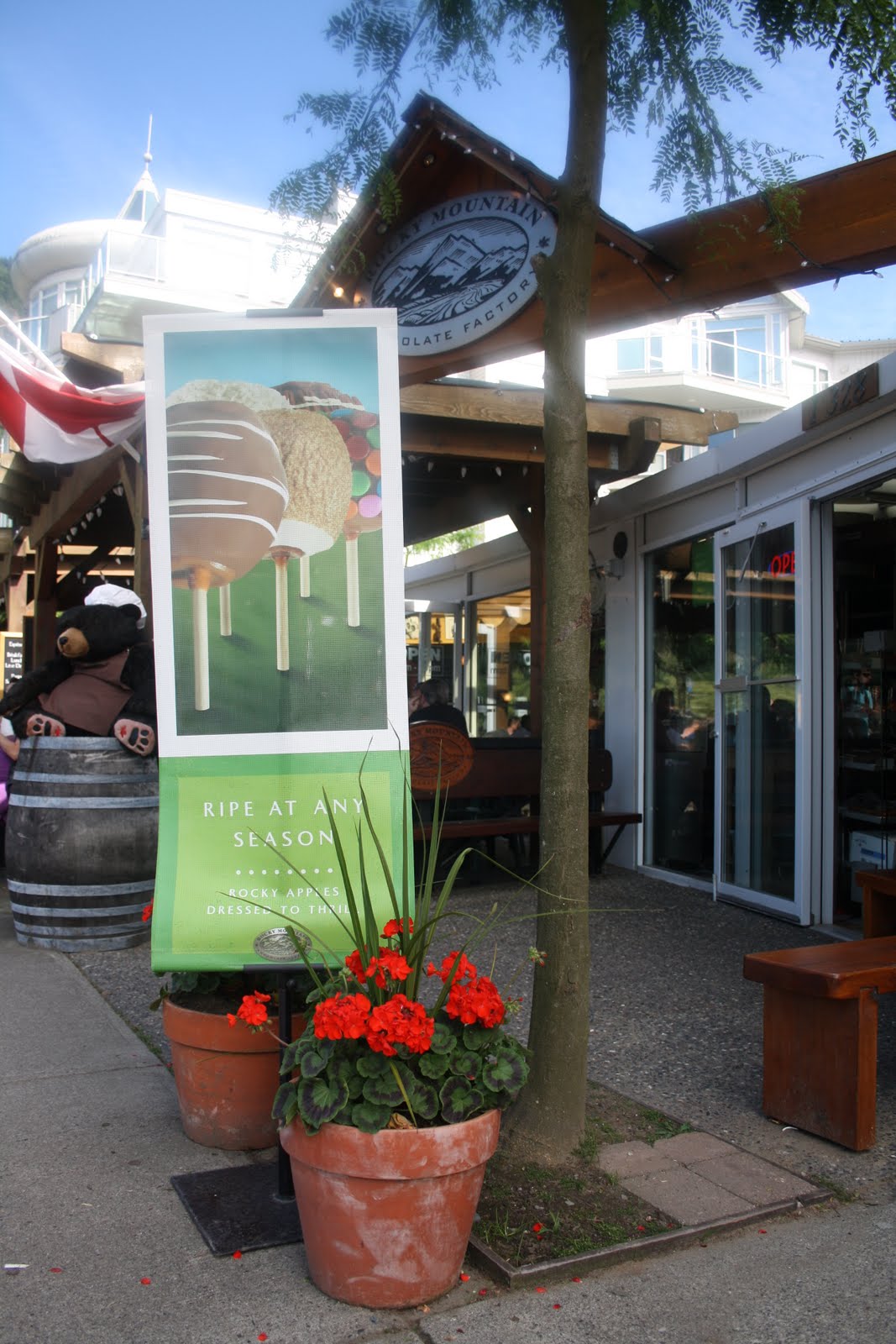
A tart, crisp apple coated in delicious chocolate, caramel and almonds. Yummy.

Where many, many local teenagers work for the summers. There's also a great coffee shop next door.

A dragon boat regatta was happening, with thousands of participants.

One of the dragon boats coming into shore with the caller/drummer at the bow.


A wonderful and famous Canadian painter named Toni Onley used to come here, too. He would fly in on his float plane to sketch and paint. He would not paint scenes like the ones I posted above, of people, shops and flowers. He painted scenes much more like this one:


Unfortunately, Toni Onley died in a plane crash several years ago. I grew up knowing and admiring his work and only now am I able to put into words the beauty and mystery of his deceptively simple layers of watercolour. People are often heard to exclaim, when viewing a coastal landscape, "That looks just like a Toni Onley painting!" Toni could capture the essence of place and landscape like few others can. He painted abstracts, arctic landscapes, and scenes from Mexico, Hawaii, and the BC Coast. His paintings seem to float somewhere between earth and heaven, and he is loved equally among art critics and 'regular folks'.

Someone once said that great art picks up where nature ends. And so I leave you with one of Toni's works.


I found this painting on the Winchester Galleries website. I'm having trouble providing a link, so if you google 'Winchester Galleries Toni Onley" you will find more of Toni's wonderful work. The site is well worth the visit.